Community Case Study: Strengthening the Whole Community Through Cross-Faith Collaboration
Community Case Study: Strengthening the Whole Community Through Cross-Faith Collaboration
Client Type: Community-Based Organizations & Faith Institutions
Focus: Unity, Sustainability, and Shared Community Impact
Consultant: Buna Consulting
Overview
In many communities, individuals naturally organize themselves around faith institutions. These spaces provide spiritual guidance, belonging, and cultural continuity. However, over time, an unintended challenge emerged: the broader community structure weakened as energy, resources, and leadership became siloed within individual faith groups.
Several faith-based and community leaders approached Buna Consulting with a shared concern:
“How can we strengthen our entire community—without asking people to leave or dilute their faith?”
Buna Consulting helped design a model where faith identity remained intact, while community-wide collaboration unlocked greater collective strength.
The Challenge
The community faced several systemic issues:
- Most engagement and leadership existed only within faith institutions
- General community organizations lacked participation and resources
- Community-wide initiatives struggled due to fragmentation
- Faith groups operated independently despite shared goals and challenges
- Members experienced burnout by carrying similar responsibilities in isolated spaces
While faith institutions were strong individually, the collective community voice and capacity were weakened.
Buna Consulting’s Insight
Buna Consulting identified a key opportunity:
People did not need to leave their faith communities—they needed a shared table where faith communities could collaborate.
Rather than competing structures, Buna Consulting positioned the general community organization as a bridge, not a replacement.
Solution: A Cross-Faith Community Framework
Buna Consulting helped establish a collaborative framework that:
- Respected each faith group’s autonomy and values
- Created a neutral community platform for shared issues
- Defined clear roles between faith institutions and the broader community organization
- Encouraged representation from multiple faith groups
- Centralized non-religious initiatives such as:
- Youth development
- Social services
- Advocacy
- Education
- Economic empowerment
Faith groups continued to focus on spiritual life, while the general community organization focused on shared civic and social advancement.
Results & Positive Outcomes
The impact was transformative:
- Stronger collaboration across different faith groups
- Increased participation in community-wide initiatives
- More effective use of volunteers and resources
- Reduced burnout through shared responsibility
- A unified community voice in external partnerships and advocacy
- Faith institutions became stronger beneficiaries, not weaker participants
By working together, each faith group gained access to broader resources, networks, and opportunities—without compromising beliefs or identity.
Why This Model Worked
This approach succeeded because:
- It honored faith as a strength, not a barrier
- It replaced isolation with coordination
- It aligned spiritual values with practical community outcomes
- It transformed competition into collaboration
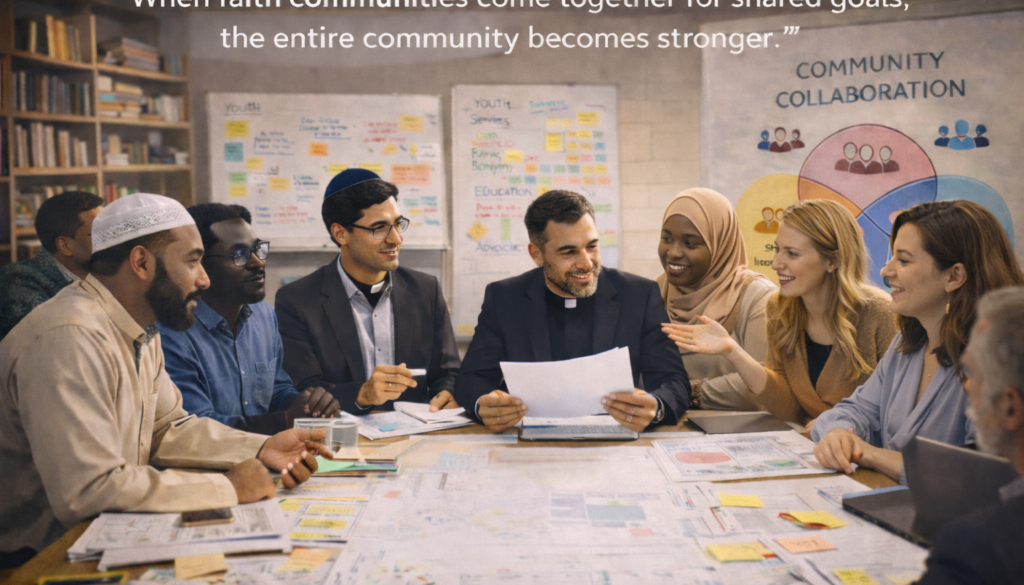
“When faith communities come together for shared goals, the entire community becomes stronger.”
Long-Term Impact
Today, the community operates with:
- A clear distinction between spiritual leadership and community governance
- Stronger institutions across faith and civic spaces
- Sustainable community programs supported by multiple stakeholders
- Increased trust, unity, and collective ownership
Buna Consulting’s Role
Buna Consulting served as a neutral facilitator and system builder, helping the community design structures that promote unity without uniformity.
We believe:
Strong faith communities and strong general community organizations are not opposites—they are partners.